
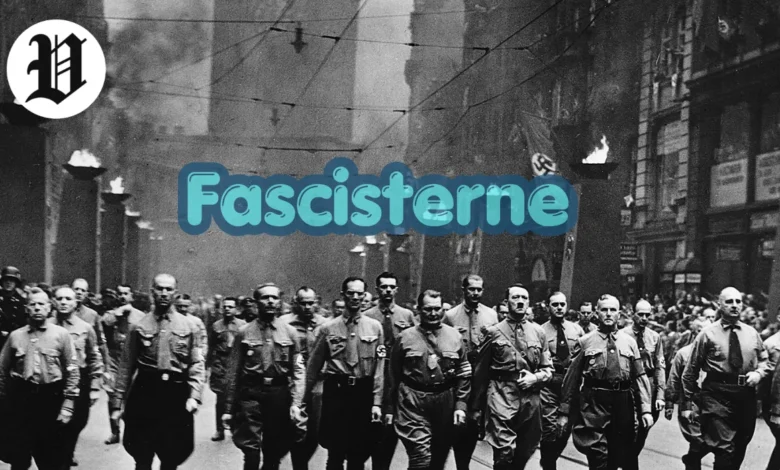
Fascisterne is a Danish word. It means “the fascists” — the plural definite form of fascist, pointing to a specific group rather than a vague concept. The linguistic packaging is Scandinavian, but what it contains is a 20th-century political catastrophe that reshaped the world.
The Word’s Origin
Start with the root. The Italian term fascismo derives from fascio, meaning “bundle of sticks,” itself from the Latin fasces — an ancient Roman symbol of civic authority, a bundle of rods tied around an axe, carried by the lictors of magistrates. The symbolism was deliberate: a single rod breaks easily; the bundle does not. That image of strength through enforced unity became the founding metaphor of an entire political tradition.
How Fascism Rose to Power
Mussolini invented the brand, Hitler perfected the nightmare. In 1919, Mussolini founded the Italian Fasces of Combat in Milan, which became the National Fascist Party two years later. The ideology spread fast, partly because the post-WWI moment was tailor-made for it. Fascism arose in the aftermath of World War I, a period marked by economic devastation, political instability, and widespread disillusionment. Many European countries faced unemployment, inflation, and social unrest, while traditional political systems appeared incapable of addressing these crises. Desperate people tend to accept dangerous solutions when nothing else appears to be working.
What Fascisterne Actually Believed
What defines fascisterne as a political force — not as a slur, but as a historically documented movement — comes down to a cluster of interlocking features. They rejected political pluralism and sought to eliminate opposition. Political parties, independent media, and civil society organizations were either controlled or dismantled entirely. Dissent was not tolerated; it was met with censorship, imprisonment, or violence.
Add to that a cult of the leader, glorification of military force, and state-directed economic control that kept private property intact while subordinating it entirely to national goals. The nation was treated as a living organism that had to be purified, strengthened, and expanded — with any internal difference treated as a threat to that organism’s health.
People also see: Dandork63: Your Complete Guide to Modern Digital IdentityDenmark and the Word
Denmark’s specific relationship with fascisterne is worth understanding separately. From 1940 to 1945, Denmark was occupied by Nazi Germany. Most Danish citizens resisted or stayed neutral, but some groups collaborated with the occupiers. These collaborators were called fascisterne. After the war, many lost their positions and some faced trial. The word in Danish is not just ideological shorthand — it is a moral verdict tied to lived betrayal, which is why it still carries particular emotional weight in Scandinavian political discourse.
The Problem With Overusing the Word
The harder question isn’t historical. It’s current. Today, fascisterne is sometimes deployed too broadly in political debates — applied to anyone a speaker strongly disagrees with, regardless of whether the accused actually holds fascist positions in any documented sense. Orwell flagged this exact problem in 1944, noting that by then “fascist” had become little more than a synonym for “bully.” When a word gets applied to everything, it describes nothing.
That said, the dilution problem cuts both ways. Insisting the label only applies to card-carrying Mussolini admirers makes it functionally useless for analyzing real patterns. The honest position is neither reflexive application nor defensive deflection — it’s asking whether specific, documented behaviors match specific, documented characteristics.
people also see: American Labor Day: The History You Never Learned
Why It Still Matters
The more durable lesson of fascisterne isn’t about any single regime. It’s about conditions. Economic collapse, institutional failure, and a population exhausted by instability — these are the ingredients that keep reappearing across different countries and different centuries. Fascism didn’t arise because a few evil men had bad ideas. It arose because millions of ordinary people decided, under pressure, that order mattered more than freedom.
That’s the part worth remembering. Not the symbols or the salutes — but the mechanism. The slow series of concessions that made each next step seem reasonable, until it wasn’t. Studying fascisterne is not an exercise in historical guilt. It’s a map of how democracies come undone, drawn by people who lived through it.